September 16th, 2016

Opening The Sales Call – Part Two


You will often find yourself opening the initial sales call and having follow-up meetings. In both types of meetings, you will open the call in a similar fashion.

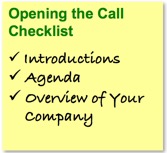
You will follow the Opening the Call model, which shows the steps for an initial call.opening-the-sales-call-checklist

In follow-up meetings, you will simply summarize what happened in the prior meeting, instead of making introductions.

However, in some cases, there will be new decision makers who attend the meeting. In that case, you will summarize as well as make introductions.

Opening The Sales Call Model

This is the model you will follow when you open a call.


Make Introductions

  • Make sure you know the names and roles of everyone in the meeting
  • (No time for small talk for today’s busy customers!)


Tips for Introductions

  • Keep them brief
  • Know everyone’s name; take notes
  • Thank them for their time beforehand
  • Plan a transition to next step, “Confirm Agenda”


Confirm agenda

  • Bridge from how you got the meeting (referral, idea, etc.)
  • Confirm purpose of meeting and timing


Provide an Overview of Your Company and Your Products/Services.

Summarize what your company does and present a mini case study (explain a challenge a customer faced, how you helped them, and the results the customer achieved).


Shift to focusing on the Customerstrategy-planning

 
Listening and Questioning

  • Business discussion
  • Summarize
  • Advance to next step


Tips for Opening The Sales Call

  • Remember that sales is a long-term process; success doesn’t happen overnight
  • Prepare to be an insightful outsider. You can offer a fresh perspective to your prospects and “see the forest through the trees.”
  • Connect with prospects. Relate your communication to their vision, values and core competencies.
  • Conduct extensive company research and plan effectively before making your initial sales call.
  • Commit to continued self-improvement.
  • Above all, always be yourself!


Successful Traits for Opening the Sales Call

The sales process helps us stay on track. That’s one way to ensure success. Another way to ensure success is to demonstrate certain traits.

Successful salespeople are:

  • Confident
  • Sincere
  • Engaging

Happy Selling!

The Sales Coaching Institute

September 14th, 2016

Opening The Sales Call – Part One

Opening The Sales Call

sales-process-templateLet’s quickly review the sales process. First, you spend time prospecting and identifying qualified leads. Next, do your homework and convince the prospect to meet with you. Now, you are about to meet face-to-face with this prospect.

This step, Opening the Sales Call, is about making a good first impression, positioning yourself as an expert and setting a positive tone for potentially doing business.

As you get to know the prospect and ask questions to understand his needs, you will determine if there is a solution your company can provide to fit his needs. Once your present that solution, you may need to overcome objections and then you will close the deal.

Lastly, you will continue to cultivate the relationship, and develop the client for life.

In this video training series, we will talk about opening the initial sales call and opening follow-up meetings. In both types of meetings, you will plan to open the call in a similar fashion.

In sales follow-up meetings, you will summarize what happened in the prior meeting, instead of making introductions. However, in some cases, there will be new decision makers who attend the meeting. In that case, you will summarize as well as Make Introductions.


What is an opening? It is a starting place, you are planting seeds to grow the relationship.


Successfully Opening The Sales Call Involves:

– Good First Impressions

– Position Yourself As An Expert & Trusted Advisor

– Setting a Positive Tone For Doing Business

– Above All, Always Be Yourself!


We are excited about your interest in becoming an expert on opening the sales call. We have eleven more consultative sales training videos and blogs designed just for driven sales reps like yourself that will teach in more detail the following.

  1. Planning The Opening Sales Call
  2. Practicing The Opening Sales Call
  3. The Importance of An Agenda For the Opening Sales Call
  4. The Importance of Making a Positive First Impression on The Initial Sales Call
  5. Creative Ways To Build Rapport During The Initial Sales Call
  6. The Importance of Understanding and Utilizing Open Ended Questions During The Sales Call
  7. The Importance of Being Your Authentic Self
  8. The Benefits of a Positive Opening Sales Call
  9. How To Transition From Introduction To The Sales Agenda
  10. How To Adapt To Meet Client Expectations During The Sales Call
  11. Getting Into The Sales “Flow Zone”

HAPPY SELLING,

Your Sales Coaches & Trainers at The Sales Coaching Institute

SUCCESSFUL SALES PEOPLE ARE

  • Confident
  • Sincere
  • Engaging
  • Able to ask the right questions
  • Good listeners
  • Able to identify and articulate the right solution

September 7th, 2016

Sprint Selling – New Revenue-Producing Sales Strategies

Sprint Selling – How To Quickly Develop & Prototype New Revenue-Producing Strategies That Deliver Results!

Primarily, the two most popular business models are now defunct. The first one, centralization by function, just means that almost all of the functions of daily running were in-house. While this business model still works to some degree, new revenue-producing strategies must be implemented to ensure that you keep a competitive edge and hit your monthly sales objectives.

The second model used decentralization by region or product, which just means that there were various branches of the store in different states, cities, regions, etc., all selling the same products/services. Likewise, the products/services could be based in particular areas, such as Indian-style dresses in India and Midwestern styles in the US. Both of these models worked well for the last 25 years and still can work today, as long as you can develop and prototype new strategies to help deliver the results you want.

The Virtual And Velcro Models

Now, more and more corporations are focusing on two new models of sprint selling, called Virtual and Velcro.

Virtual Model

With the virtual business model, almost everything is done online (and some companies only work online). Keeping up with consumer culture is an important way to understand the interests of clients. With everyone focused so much on technology and what it can do, it makes sense that almost every company in the US would have a website, if not a virtual store. A recent Fortune 500 Survey of CEO’s asked, “What is your # 1 concern in 2016.” The answer – “The rapid pace of technological change.” That’s why it’s critical to have a strong grasp on those emerging technologies that can help to make your business more competitive.

Velcro Model

Likewise, the Velcro model works by completely pulling apart the company and reassembling it in a new way or a new location. More and more companies are focused on implementing the Velcro business model because that means they’re always ready to start over and create something new that will offer the results they want.

The best way to develop and implement new revenue-producing strategies is to focus on what the customer wants/needs, what your team can do to help them, and keeping costs as low as possible while still delivering great results.

Happy Selling!

The Sales Coaching Institute

August 30th, 2016

The Sales Pipeline Checklist

Sales Pipeline Checklist

The sales pipeline or funnel is a systematic approach to selling a product or service. It is also a good way to keep track of progress. It can show a “snapshot” of your sales operation at any point in time.

Each step in the pipeline or funnel has clearly defined criteria that need to be addressed before the opportunity can move further along. In other words, leads become more and more qualified as they work their way through the funnel. The funnel also provides a great way to track and forecast sales as well as gauge marketing activities.

By reviewing a Sales Funnel Report, the sales rep can easily see how many leads are at each step, if there are any “bottlenecks”, or if there are an insufficient number of leads at any stage. Armed with that knowledge, the sales rep may then decide to shift his focus. He can then also work closely with the sales and marketing managers to determine whether they are generating enough leads to hit sales goals, whether the leads are of high enough quality, or what further actions need to be taken to help him reach his territory objectives.

Use a sales pipeline checklist to help organize your sales process and close more business.

New Opportunity
Initial Communication ¨ Initial contact made

¨ Opportunity reviewed with sales manager

¨ Business problem and need to take action is identified

¨ It appears that my company can satisfy the need

Fact Finding and Qualification ¨ Qualifying checklist completed

¨ Decision-making process is identified

¨ Business problem and need to take action is confirmed with prospect

¨ Problem owner agrees to be advocate for my company

¨ Ultimate decision maker (UDM) identified

Develop Solution ¨ UDM commits to obtain funding for solution

¨ Competition is identified

¨ UDM confirms decision within 90 days

¨ My company’s solution and implementation is identified

¨ Prospect’s funding is approved and committed

Propose Solution ¨ My company agrees on solution and implementation strategy

¨ Proposal submitted to prospect

Solution Evaluation ¨ Decision making process is reconfirmed with UDM

¨ Prospect commits to make a decision within 30 days

Negotiation ¨ Negotiations completed

¨ Terms and conditions are agreed upon

¨ Agreement is signed

Purchase Order ¨ Purchase order is issued

¨ Implementation plan is finalized

Account Maintenance ¨ Implementation begins

¨ Revenue is booked

¨ Customer satisfaction process begins


Related Article:

Sales Qualifying Checklist


Happy Selling!

The Sales Coaching Institute

salescoach.us

August 30th, 2016

Sales Qualifying Checklist

Use this sales qualifying checklist to help guide you through your sales process.

The qualifying process is often compared to a funnel where new leads coming into the system (i.e., opportunities) are initially placed at the top of the funnel (the widest part) and then worked through the system by qualifying, developing, proposing, and evaluating solutions, negotiating and then at the narrow part of the funnel, a purchase is made and implemented.

Need

Every prospect is going to have a set of needs. It is up to you to determine what those needs are and how your product or service can help satisfy their needs.

  • Are you aware of all their needs?
  • Does the prospect acknowledge that a significant problem exists and she must take action?
  • Is their need a high priority (need to buy is quantified, the prospect is committed)?
  • Can you provide a unique solution for their need?

Decision Making

Are you talking to the right person?  Here are some key questions you need to ask yourself before you pitch your product or service to the wrong person.

  • Are you speaking to the Ultimate Decision Maker?
  • Are you speaking to the problem owner?
  • Have you identified influencers and approvers? Do you know who else is involved?
  • Are you aware of the RFP process? (Are they giving you influence on the RFP? Did the competition write the RFP? Is there a formal buying process in place?)

Solution

If you are not solving a problem, you may be wasting your time. It is not enough to simply boast about the features and benefits of your product. You must be able to solve a problem or provide sufficient evidence that your product/service is worth their money and time.

  • Is there a solution that you can supply and support?
  • Is it within your company’s current product mix?
  • Is your solution ‘original’ or unique and better/different than the competitions?

Funding

Learning about the prospect’s finances can help you determine if your product or service is within their budget. Save yourself some time and ask yourself the following questions about your next prospects’ available funding.

  • Is there a budget allocated?
  • How much is it? Is funding committed and approved?
  • Is it reasonable; can you provide a solution for that amount?

Competition

Know your competition. Read this article to learn more about your competition and what you should be evaluating and acting on. 22 Questions About Your Competitors You Need  To Answer

  • Do you know who you are competing against?

Timing

Make it a habit to keep a detailed schedule about your prospect’s timing. This information can help you organize your prospects & buyers who are committing within a specific timeframe.

  • Are you aware of their timetable to take action?
  • Is their timing reasonable?
  • Does it fall within your own ‘sales cycle’ criteria?

Size

This one is hard to miss, but you should always make sure to keep track of your prospect’s actual size and size potential. This can help you anticipate solutions to problems before they ever happen. Now that is forward-thinking!

  • Is the potential order value worth the effort?
  • Is your company large enough to handle it?


By using a sales qualifying checklist in your sales process, you will always be more organized and process orientated, resulting in more qualified leads and more closed sales! Making the smart decision to stay organized with a checklist also provides a way to look back on your accomplishments and progression over time.

Happy Selling!

Do you like what you just read? Check out our Business Acumen Training to see how you can develop a keen eye for sales opportunities.